

Startup Operations
The International Founder’s US Company Operations Stack
A practical guide to the entity, EIN, addresses, phone, banking, payment, and filing systems an international founder needs after forming a US company.
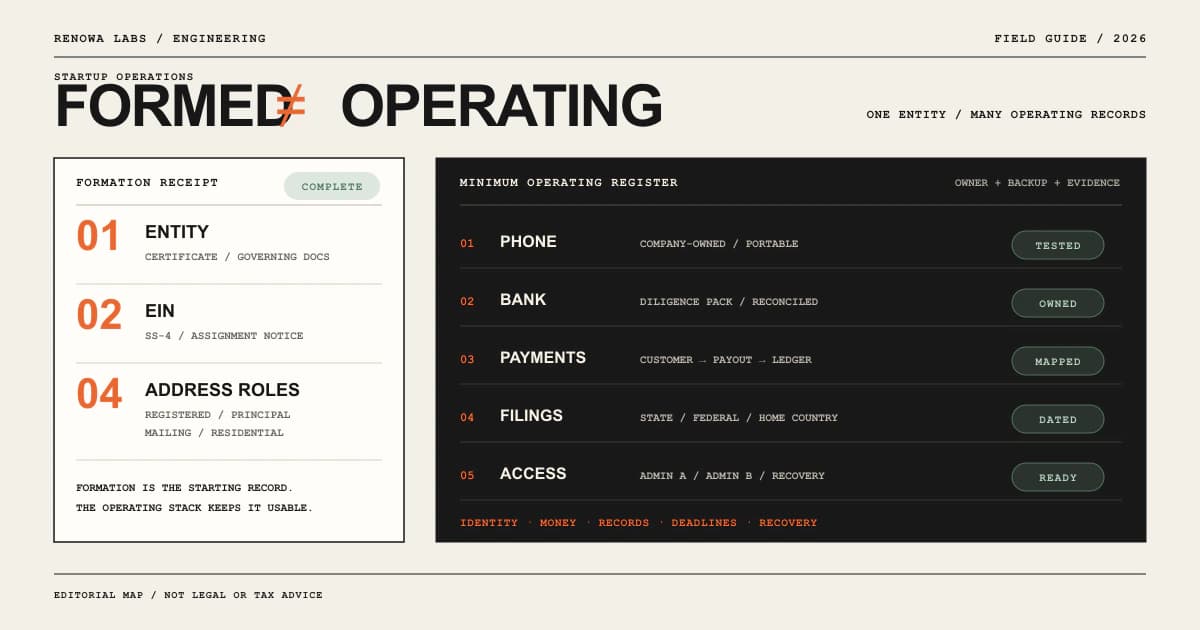
Forming a US company from another country is often presented as a short checkout flow. The formation is the easy part. The operating system around the entity—tax identifiers, addresses, banking, phone access, payment accounts, annual filings, and recovery ownership—is what determines whether it remains usable.
This guide is an operations map, not a recommendation to incorporate in the United States. A US entity can create tax, reporting, banking, and legal obligations in the founder’s home country as well as in the United States. Decide the jurisdiction and entity type with advisers who understand both countries. Then build the following system deliberately.
Start with the business reason, not the formation provider
A venture-backed company, a bootstrapped software studio, and a solo consultant do not necessarily need the same structure. US investors often expect a Delaware C corporation. A limited liability company may be simpler for some owners but can be awkward for fundraising, equity compensation, or tax treatment across borders. Incorporating because a payment platform looks easier is not a complete entity strategy.
Write down four facts before buying a formation package:
- Where the founders and employees perform the work.
- Where customers are located and what they buy.
- Whether institutional investment or employee equity is likely.
- Who will prepare US and home-country filings.
The formation vendor can submit documents. It cannot decide how another country will classify the company, whether the company creates a local permanent establishment, or how the founder should receive money.
Separate the four address roles
Founders frequently use “company address” as if it were one field. In practice, the stack may contain four different roles:
- Registered agent address: where official state and legal notices are received. This is not automatically a general mailbox or operating location.
- Principal business address: where the company is actually managed or conducts business. Banks and payment providers may ask for evidence supporting it.
- Mailing address: where ordinary correspondence can reliably reach the company.
- Founder residential address: often requested privately for identity and beneficial-owner verification.
Do not put a registered-agent address into every form by habit. A mismatch between formation records, tax forms, bank records, and payment accounts creates manual reviews. Maintain an internal address register showing which address was supplied to each institution and the evidence available for it. If an address changes, update the register before starting provider updates.
Obtain the EIN through the correct route
The Employer Identification Number is the company’s federal tax identifier. According to the current IRS Form SS-4 instructions, an applicant whose principal place of business is outside the United States cannot use the online EIN application. International applicants can use the IRS international phone line, fax, or mail routes described in the instructions.
The IRS says a completed fax application can generally receive a faxed EIN response in about four business days; mail processing is approximately four weeks. Those are service estimates, not guarantees. Apply using one route and keep the complete SS-4, delivery confirmation, and EIN assignment notice together. Duplicate applications can create a second identifier that must later be resolved.
Use the company’s exact legal name and responsible-party details consistently. Do not let a vendor hold the only copy of the EIN notice. Store it in a company-controlled document vault with access for at least two authorized people.
Treat the phone number as an operating channel
A US business number can make sales and support easier across time zones. A business VoIP service such as Quo can provide shared calling, messaging, routing, and a US or Canadian number without tying the company to one founder’s personal SIM.
But a virtual number is not an address and is not guaranteed to receive every bank or platform verification code. Some services reject VoIP ranges for authentication. Before making a number canonical, test inbound calls, SMS from important providers, international forwarding costs, voicemail ownership, number-porting rules, and what happens if the primary administrator loses access.
Use role-based routing such as sales, support, and billing. Keep the number in the company account, not a founder’s personal account, and record a port-out PIN or recovery method securely.
Build banking and payments as two separate layers
A bank account stores and moves company funds. A payment processor or merchant of record accepts customer payments. Approval by one does not guarantee approval by the other.
Expect each provider to verify some combination of formation documents, EIN, ownership, residential address, business model, website, contracts, expected transaction volume, and source of funds. A formation provider’s partner flow can reduce data entry, but its availability and approval criteria can change. Stripe Atlas’s banking guide is useful as an example of the questions partner banks ask, not as a promise of an account.
Keep a diligence pack ready:
- formation certificate and governing documents;
- EIN notice;
- ownership register and founder identity documents;
- plain-language business description and live website;
- customer contract or invoice examples;
- address evidence;
- expected countries, currencies, volumes, and average transaction size.
Reconcile the bank, payment provider, and accounting ledger every month. Payouts are usually net of fees, refunds, taxes, and disputes, so a bank deposit is not itself a complete revenue record.
Put recurring filings on a named calendar
State formation creates state obligations. For example, a Delaware LLC currently owes a $300 annual tax due June 1 and does not file an annual report; the Delaware Division of Corporations also lists a late penalty and monthly interest. Delaware corporations have a different annual report and franchise-tax calculation, with two permitted calculation methods described by the state’s franchise-tax guidance.
Federal obligations depend on the entity and ownership. A foreign-owned US disregarded entity may need a pro forma Form 1120 with Form 5472. The IRS Form 5472 instructions describe reportable transactions and a $25,000 failure-to-file penalty. This is one of the reasons a “company with no revenue” should not be assumed to have no filing.
Beneficial ownership rules also change. FinCEN’s current BOI reporting page says US-created companies are exempt under the March 2025 interim final rule, while certain foreign entities registered to do business in the United States remain in scope. A foreign founder’s US-created LLC is a domestic entity; it is not the same as a foreign company registering a branch. Recheck the official rule near every filing decision rather than copying an old formation checklist.
The minimum operating register
Create one company-owned record with these fields:
- obligation or provider;
- legal entity and jurisdiction;
- account owner and backup owner;
- login or role email;
- renewal or filing date;
- expected amount and payment source;
- required documents;
- adviser or support contact;
- completion evidence;
- recovery path.
Review it monthly and after any founder, address, bank, or administrator change. The goal is not more paperwork. It is to make the company operable without relying on one person’s memory.
Next steps
- Ask a cross-border adviser to confirm the entity and owner filing map.
- Separate registered, principal, mailing, and residential addresses in your records.
- Put the EIN notice and formation documents in a company-controlled vault.
- Prepare one reusable banking and payment diligence pack.
- Schedule state, federal, home-country, registered-agent, and provider renewals with named owners and backups.
The strongest international company stack is not the one with the most providers. It is the one whose identity, money, records, deadlines, and recovery paths agree with each other.